Why we’re building it
Fewer people come to the news through a front page now. More of them ask ChatGPT, read a summary from Apple Intelligence or get an alert on a wearable. In that world the article becomes one output among many. What has lasting value is the reporting itself: the facts someone checked, the quotes someone cleared, the context someone gathered. That reporting is also what keeps an AI agent from inventing things.
Our earlier AI News Agents work made the risk concrete. Once an agent can rewrite a story in ten different voices and publish on its own, the reporting at the center can quietly drift. So the question for Spring 2026 was simple to ask and hard to answer: if the reporter’s job shifts from writing the article to establishing what’s true, what should they hand to the machines?
Bedrock: human ground truth
The Bedrock team started by taking journalism apart. They built an eight-step deconstruction tool and used it to reverse-engineer published stories across eight beats, from local news and sports to health and investigations, breaking each one into its atomic parts: sources, claims, data, media and context. The question was what “ground truth” actually looks like in each kind of story. A sports recap is dense with quantitative claims; an investigation leans on documents and anonymous sources; a local story mixes officials and neighbors.
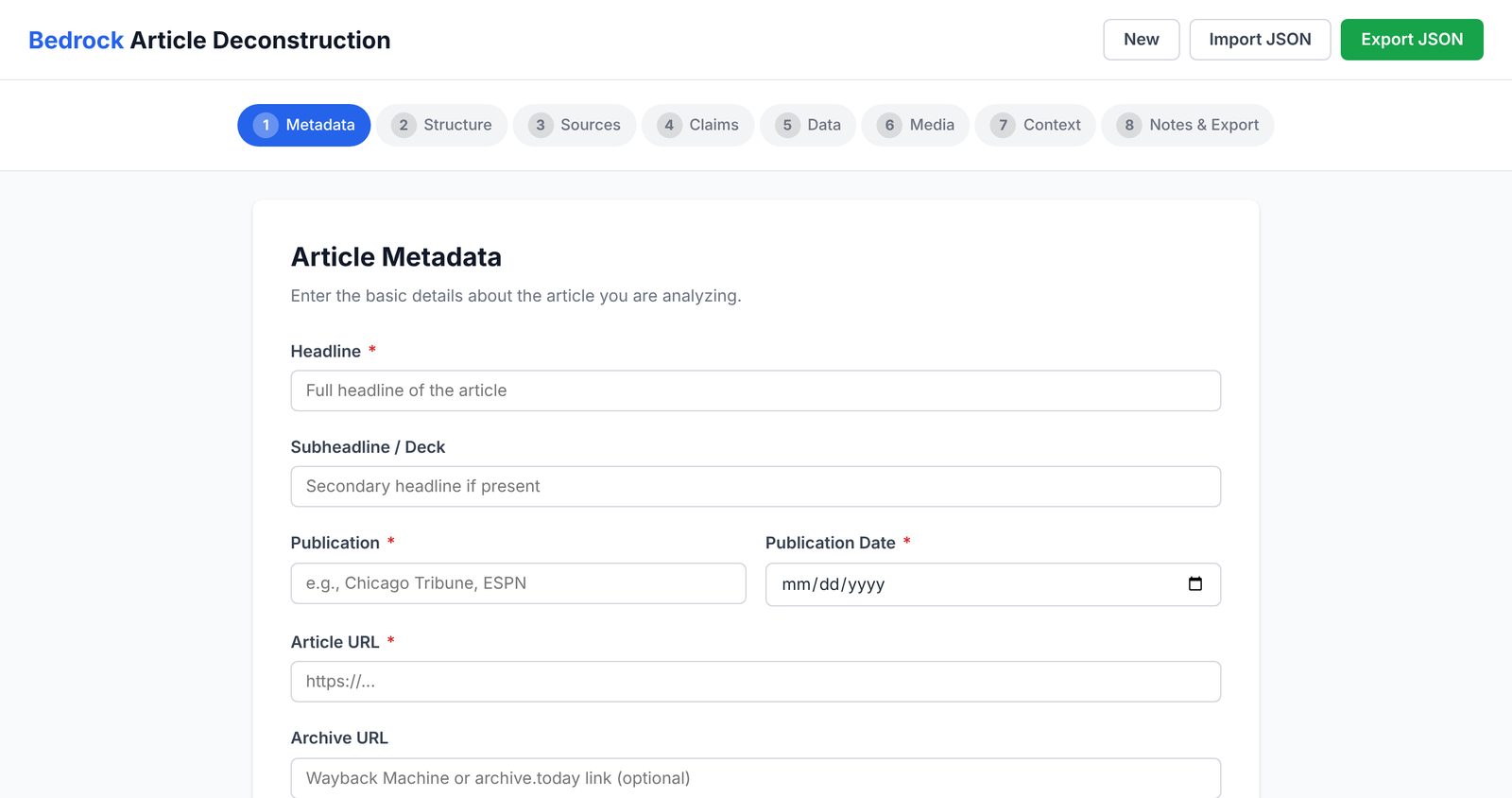
From that research came the package itself: a machine-readable dispatch that a reporter fills in and clears before any AI touches it. It separates verified facts from claims, and marks each claim’s verification status: verified, partially verified, unverified or contested. Sources appear only as they’re cleared to appear, quotes are verbatim, and the reporter can set explicit framing rules such as “do not identify the eyewitness” or “do not state the cause.” AI agents can then turn one package into a short video, a conversational Q&A or an audio alert, with the goal that every sentence they produce traces back to something a human verified.
The prototype went through two rounds of testing, and the feedback shaped it: let me drop in a pile of files and sort them for me, show me clearly what’s published versus draft, and send a published story back to draft when new material changes it.
A companion project, Mirror, comes at the same problem from the audience side.