Knight Lab Studio

I created Knight Lab Studio, where interdisciplinary teams of journalism, computer science and design students prototype new forms of journalism and media. It has run as a class since 2016, and I ran it every quarter for 12 years.

Knight Lab Studio Screenshot
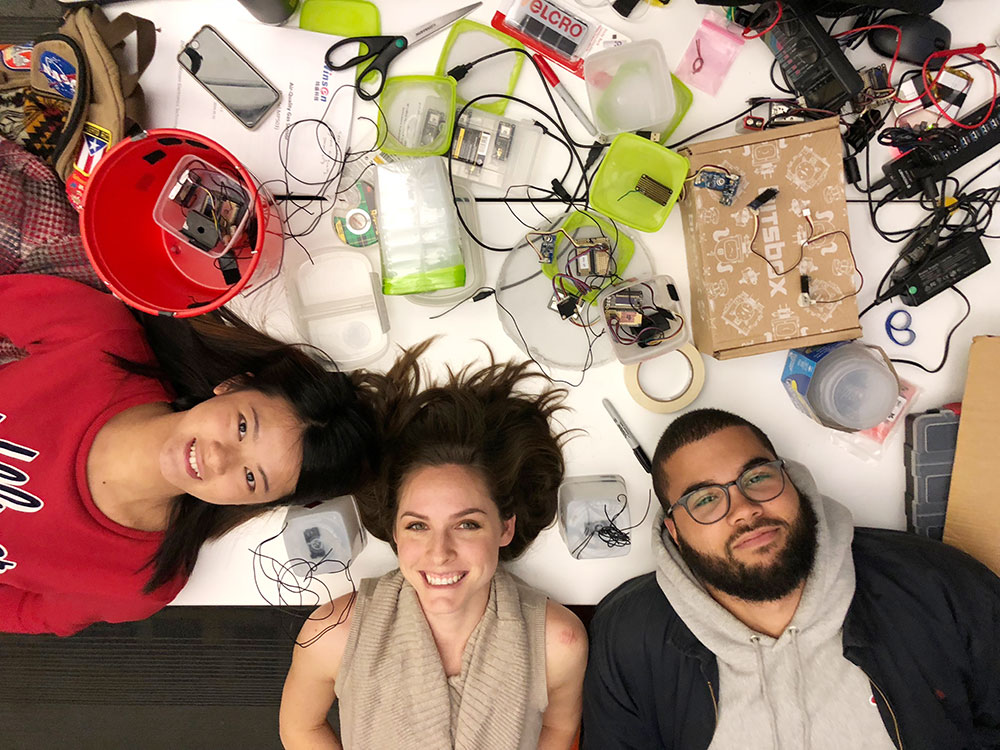
Knight Lab Studio students at work
View Project

Role

Creator Faculty Lead

Technology

Generative AI AR / VR Sensors Prototyping

What Studio is

I created Knight Lab Studio at Northwestern. A prototype version ran around 2014, and it has run as a class since 2016. I ran it every quarter for 12 years.

In Studio, interdisciplinary teams of journalism, computer science and design students prototype new forms of journalism and media. I have been a lead on 31 Studio projects.

Generative AI

Recent Studio work centers on generative AI: Bedrock, Mirror, AI News Agents and the audit of bias in AI images.

Selected Studio projects

BedrockKnight Lab Studio

As people get more of their news through AI assistants, the story itself is no longer the only product. The part that matters is the verified reporting underneath it. Bedrock asks what a reporter should hand to the machines, and packages that human ground truth so AI agents can build on it without making things up.

MirrorKnight Lab Studio

How a story lands in different communities is central to trust, but most newsrooms can't afford focus groups. Mirror lets a journalist interview AI digital twins of real audience segments about a draft before it runs, and asks how to make those twins authentic, stable and honest about what they are.

AI News AgentsKnight Lab Studio

Starting in 2023, well before AI-generated video flooded every feed, Studio teams set out to prove that AI hosts could write, voice and publish their own short news videos. Over three terms they went from a local model reading articles aloud to autonomous agents with distinct personalities. The outputs were rough, sometimes cringeworthy, and that was part of the lesson: the project showed what was coming, and where the real value ends and the uncanny valley begins.

Auditing AI Images for BiasKnight Lab Studio

Plenty of news stories have no image to go with them, and AI image generators look like an easy fix until you see who they picture as a construction worker or a social worker. This multi-year Studio project built an article-to-illustration pipeline, ran into the bias built into the models, and ended up building a tool to measure it.

New to Town2020 Spring

When people move to a new community, they have a million questions about their new home. Meanwhile, news organizations serving that community have an interest in “meeting” those new people and converting them into subscribers. The Indianpolis (“Indy”) Star, one of Medill’s Local News Initiative partners has identified this as an opportunity in their coverage area. This project provides the opportunity to work on a real challenge in media innovation and product development. Students will...

Storytelling with GIFs2020 Winter

This project will build upon prototypes and research conducted in the Fall 2019 Studio class, but participation is open to any interested student. As the open-web continues to die, storytellers need tools that help them create sharable artifacts suitable for a variety of social networks and platforms. Brevity and portability are of the utmost importance. This project is concerned with designing a tool that allows novice storytellers to create simple 5 frame (5 images) GIFS...

Privacy Mirror2019 Winter

The average person today that has a smartphone, walks around leaking information about themselves over radio signals. WiFi, bluetooth and NFC radiate personal information into the public airwaves. These signals can tell you a lot about a person without their knowledge. To raise awareness around privacy and security for digital devices, this project will seek to create a “mirror” that reflects back information that is radiating out from anyone who stands in front of it....

Music Magazine2019 Spring

Music fans today have trouble finding the stories they want to read. Following all your favorite artists on social media is overwhelming, and searching Google turns up page after page of irrelevant junk. We’ll build a system that finds just what a fan wants to read.

Juxtapose2019 Winter

Juxtapose helps storytellers compare two pieces of similar media, including photos, and GIFs. It’s ideal for highlighting then/now stories that explain slow changes over time (growth of a city skyline, regrowth of a forest, etc.) or before/after stories that show the impact of single dramatic events (natural disasters, protests, wars, etc.). This popular tool could be more useful to storytellers and web-makers if it had a couple of key features that have come up in...

Information Spaces in AR/VR2018 Spring

An experimental design project that explores an emerging concept of information spaces. This concept is behind Microsoft’s pivot to create future Windows operating systems that exist in mixed reality headsets. Students will explore the concept of a news/information app that exists in AR and/or VR. For example, a political news feed might exist on a wall in your living room, and breaking news would appear on a coffee table, twitter reactions surround the coffee table...

Augmented Reality Visualizations2018 Winter

An experimental design project that explores visualizing data in three dimensions for augmented reality. Visualizations that can be examined and inspected by physically getting closer or understood by walking around them, open up exciting possibilities for how we communicate complex ideas and data that reveals hidden truths.

Resurrecting History for VR2018 Fall

Automated Photogrammetry. As AR and VR increasingly becomes the focus as we move away from smartphones, media organizations will have to find ways to produce content native to those mediums. These same organizations have a wealth of stories that continue to have value over time. Flat video and photo will become less desirable as we continue to move into these new spaces. Previous projects in the lab have surfaced an opportunity to take existing video...

Storytelling Layers on 360 Video2017 Spring

In this project, students will film 360 video and explore the best ways to add on that additional layer; students will finish the quarter with two videos, and will document their findings to make their storytelling methods more accessible to others.

Smarter News2017 Spring

How might we better understand how to reach our audience, delivering the right news at the right moment, or for the right mood, or for the right amount of time?

Projection Mapping2017 Fall

Imagine that any wall, building floor or doorway could come alive and tell stories. Using projection mapping, many artists, advertisers and industries are already doing it. In this project, students will explore ways in which projection mapping is currently being used and adapt them for journalistic purposes. Students will build and prototype their adaptations.

Photojournalism in 3D for VR and Beyond2017 Spring

In this project, students will use modern approaches to making 3D images both with hardware and software processing.

Environmental Reporting with Sensors2017 Spring

Sensor journalism uses sensors to collect information about our environment. It opens new possibilities for journalists enabling them to collect and process data that might not be available or at a level of detail not previously available.

Storyline: Charts that tell stories.2016 Fall

One of the most common problems we see in data storytelling is how and when to introduce an editorial layer onto a visualization. Mobile devices afford us very little real estate to work with, and interactivity must be limited. But without a “story” layer, users are left without the context to understand what events might impact or inform a trend. They see something going up or down but don’t see why. “Storyline” will be a...
Podcast Discoverability2016 Fall

The podcasting landscape is overcrowded, with larger voices from legacy broadcast media sometimes drowning out new entrants. Browsing for new-to-you, quality podcasts is hard, with shows scattered across distribution platforms. This team will explore how we might provide users a better path to discovering new podcasts.

Navigating Virtual Reality2016 Fall

Though many in journalism are excited about VR, few are addressing real issues with making it attractive and interactive for their audience. This story team will explore the idea of making multiple three-dimensional VR photos around a scene and linking them together so that the user can navigate it. They’ll be exploring complex VR design challenges, such as how to move around space without disorienting the user and how to easily author interactive environments.